Introduction
Sweetpotato is widely consumed across all social classes in Kenya, including in high-end hotels, where it is valued as a healthy starch alternative due to its rich nutritional benefits. Many people substitute bread with sweet potato for its health advantages. It serves as a vital source of livelihood for smallholder farmers, and its market demand is on the rise. There are several value addition opportunities, such as the production of gluten free sweet potato flours and crisps. However there is a need for creating innovative processing practices and new recipe formulations for adaptability and palatability. Addressing market fragmentation and enhancing profitability through innovative market solutions and business models are key areas for improvement. Additionally, sweetpotato is sometimes grown as a fodder crop and is recognized for its climate resilience. However, farmers face challenges including pests, diseases, and the effects of climate change. Innovations in pest management, climate adaptation, and value chain optimization are essential to support the sustainable growth of sweetpotato farming in Kenya.
Sweet potatoes varieties; There are two broad categories of sweet potato.
The staple type with white flesh and white or purple skin. This variest has a high starch and dry- matter content.
The dessert type with orange flesh and orange skin with a high sugar and beta carotene content. Commonly three distinct types of sweet potato available for commercial production include:
Orange/copper skin with orange flesh, e.g.: Beauregard, Hernandez, Beerwah Gold, NC-3, LO-323, Centennial, Darby and Jewel. South African orange cultivars such as Beauregard have long, cylindrical to heavy elliptic tubers. They have high beta-carotene content and are fairly quick growers. It may become too big and have a long growing period.
White/cream skin with white/cream flesh e.g.: Hawaii, Kestel. Blesbok, which has cream flesh color, has a high yield and a good storage life. It can produce good yield in a relatively short growing period (4 months) which is important for cold regions. It produces some long, curved sweet potatoes, especially in sandy soils.
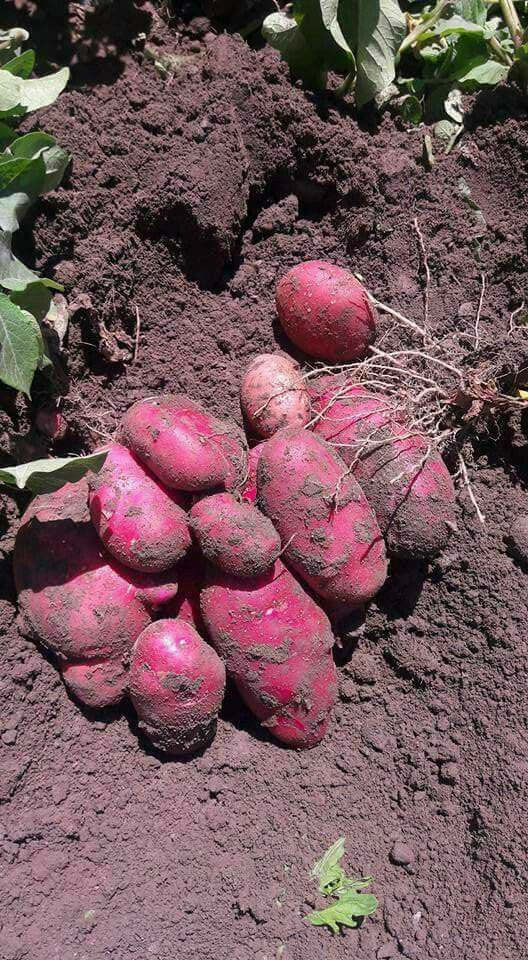
Red/purple skin with cream/white flesh, e.g.: Northern Star, Red Abundance, Rojo Blanco. Koedoe is a very attractive and tasty cultivar when cooked also with a pointed oval tuber. Its tips break off easily. It requires a growing period of 5 months to produce a good yield.
Selection of a variety to grow should be based on market demand. Varieties are assessed on a number of parameters, including root shape and uniformity, marketable yield, skin and flesh attractiveness and plant vigor.
CLIMATIC REQUIREMENTS
Temperature: Sweet potatoes are of tropical origin, they adapt well to warm climates and grow best during summer. Sweet potatoes are cold sensitive and should not be planted until all danger of frost is past.
The optimum temperature to achieve the best growth of sweet potatoes is between 21°C and 29°C, although they can tolerate temperatures as low as 18°C and as high as 35°C. Storage roots are sensitive to changes in soil temperature, depending on the stage of root development.
Soil requirements: A well-drained sandy loam is preferred and heavy clay soils should be avoided as they can retard root development, resulting in growth cracks and poor root shape. Lighter soils are more easily washed from the roots at harvest time. Wet season green manure cropping with sterile forage sorghum is recommended and should be thoroughly incorporated and decomposed by planting time.
Soil pH should be adjusted to about 6.0 by applying lime or dolomite. Rates of 240 kg and 400 kg/ha respectively will raise the pH by 0.1 of a unit. The soil should be deep ripped and then disk cultivated to break up any large clods and provide enough loose soil for hilling of beds. A yearly soil test is recommended to assess soil properties, pH and nutrient levels before planting.